PTSD/CPTSD?
Last issue, we looked at what the system called you before it had a real answer. The wrong diagnoses, the wrong treatments, the labels that stuck to the wrong things. This week, we stop dancing around it. Let’s talk about what PTSD and CPTSD actually are—in plain language, not clinical shorthand.
Too many people have some serious misunderstandings of trauma and PTSD. A quick perusal of Reddit, Facebook groups, etc. show some concerning viewpoints. One in particular I want to address here:
Several folks have made mention that trauma may have been their choice. This is never the case. You have enough shit to deal with, blaming yourself for your trauma should NOT be one of them!
Sure you may have elected to stay in an abusive relationship, but the initial trauma had already been done. Childhood abuse? Not your choice. Witnessing a tragic death? Not your choice.
Choice implies you know what is going to traumatize you. That’s hard to do, because the instinctual part of your brain and CNS (central nervous system) decide that for you. Ever tried to scare yourself?
SEXUAL ASSAULT TRIGGER WARNING: A huge bullshit flag for me, and I know many others: Rape survivors. Too many blame themselves for “putting themselves in that position.” But the more unforgiveable one is the culture, and even some clinicians, leaving the survivor feeling like they could have prevented it. Listen carefully—it was not your fault. Do not carry someone else’s fucking guilt.
So, do not blame yourself for being traumatized. Your energy needs to be focused on healing, not misplaced, or manufactured, guilt.
First, they are both the result of trauma. I go a little further than the diagnostic manuals in defining trauma by pointing out the one thing every PTSD/CPTSD survivor I know feels: some sense of a loss of safety, so absolutely that even after a situation resolves itself, you don’t “turn off” from accessing threats, because safety is never restored.
Second, they are both chronic—relentless—repetitions of the Survival Function, your instinctual self-defense mechanism. Everyone has a built-in Survival Function.
However, after trauma, the Survival Function has been updated to survive anything as grave as your trauma. And responds exceptionally well at threat reduction and avoidance.
If it determined fight, you get aggressive. If it chose avoidance, you withdraw. In some cases, your system determines the best action is to do nothing—freeze. Others placate, or fawn.
As time passes, and PTSD/CPTSD becomes more ingrained, what your mind and body senses as danger expands. What first had to be pretty damn similar to the traumatic event(s) now just has to be similar-adjacent. This is when the symptoms of both really become outwardly noticeable.
The over-reactions to benign situations—a conversation, a brush-by in a grocery store, or a rude driver in traffic. This is when your disorder becomes destructive to relationships, inwardly and externally.
But they developed differently.
PTSD is the version most people understand: the combat vet who hits the deck when a car backfires. That’s real. That happens.
But the person who grew up in a house where safety was conditional? Who learned early that love came with a price? Who got told enough times they were worthless that it starts to sound like their own voice? That’s a source of CPTSD.
With CPTSD, the trauma may have started younger, but the exposure was more prolonged and relentless—and it didn’t just leave a scar. It rewired how you regulate your emotions, how you see yourself, and how you relate to other people. That’s what makes it complex.
What makes PTSD/CPTSD so hard to overcome? Evolution.
So if trauma isn’t your choice or fault, whose is it? YOU! Seriously, but not in the way you’re reading what I just said. The autonomous self-defense protocols your mind and body put in place after trauma is the result of millions of years of evolution. Predating the existence of our species.
And your Survival Function is precisely programmed to achieve one thing: self-preservation. PTSD/CPTSD is not a malfunction. It’s a Survival Function that never turned off.
The anxiety, the hypervigilance, the distrust of crowds or other human beings, maybe even the distrust of yourself…all parts of the Survival Function.
So, if it’s natural, how can you overcome it? Well, naming it is a start, and there are differences between PTSD and CPTSD. This means there are different treatment avenues you need to pursue for each condition.
One last important part: since it is an evolutionary response to extreme danger, this is no more a personality flaw than eye color is. That’s right…
“You are not broken. You are adapted.”
Here’s where it starts to make sense from the inside.
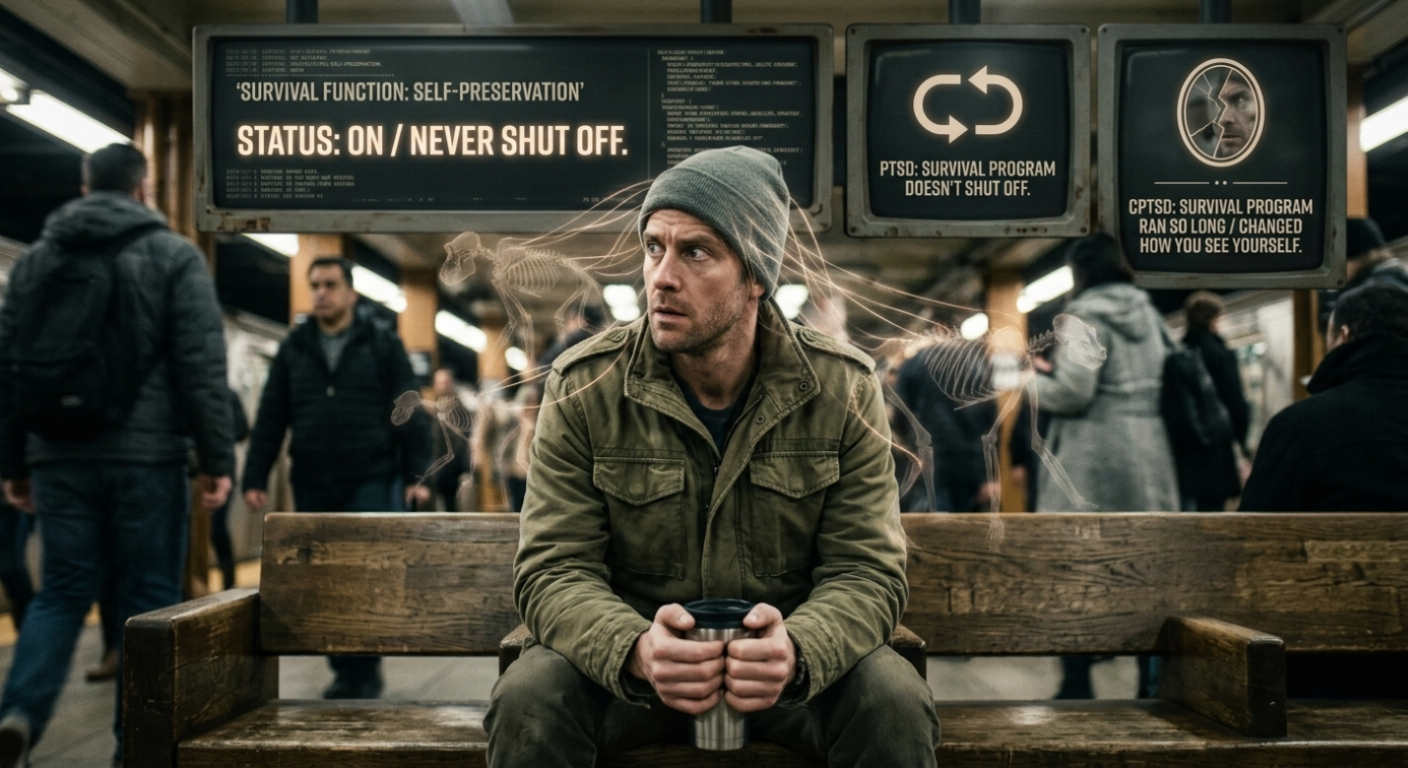
You are not moody. Your threat-detection system is working overtime.
You are not distant. You are protecting the people around you from a version of yourself you don’t fully understand yet.
You don’t just go along to get along—you give in to others out of fear of disrupting someone else’s desires. You probably learned physical or emotional pain from doing this.
You are running a safety protocol that was never designed to be permanent. Once I can get you to realize this—oh, those doors to healing start to unlock!
The hypervigilance, the startle response, the emotional shutdown, the hair-trigger—those aren’t personality traits. They’re outputs of a system under continuous load. The machine is working. It’s just working on a problem that isn’t in front of you anymore.
That’s what PTSD and CPTSD actually are: unnecessary load on a system that was only ever meant to carry it temporarily. Not every facet of your life.
Understanding this is the foundation. Not a feel-good affirmation. A fact.
The mechanism matters. Next issue, we’ll get into exactly how it works—how the Imprint spawned the Echo, and how the Echo triggers the Trauma Loop, and this thing I call the Lie that convinces you this is just who you are now.
It’s not. And I’m going to walk you through how I finally came to realize this.
Trauma was a significant emotional event that still resonates to this day in them. What you’re watching every day isn’t who they are. It’s what survival looks like from the outside.
The anger isn’t aggression. It’s a threat-detection system that never got stood down.
The withdrawal isn’t rejection. It’s someone managing a load you’re not fully seeing.
That doesn’t mean it’s easy to live with, or you have to absorb it. It means the source of your frustration isn’t someone who should know better—it’s a system running a program. There’s a difference.
Knowing they are not fixed in how they are now, and how trauma became either PTSD or CPTSD, is the difference between getting them the right help or more damaging treatments.
I’ll be here every Sunday.
Bring whatever you’re carrying.
Email me at admin@paxmentispublishing.com if there is a trauma or PTSD-related issue you would like me to speak to.
If you’re in crisis right now, please reach out. Call or text 988 (Suicide & Crisis Lifeline). You don’t have to be at the edge to call—if the weight is heavy tonight, that’s enough reason.